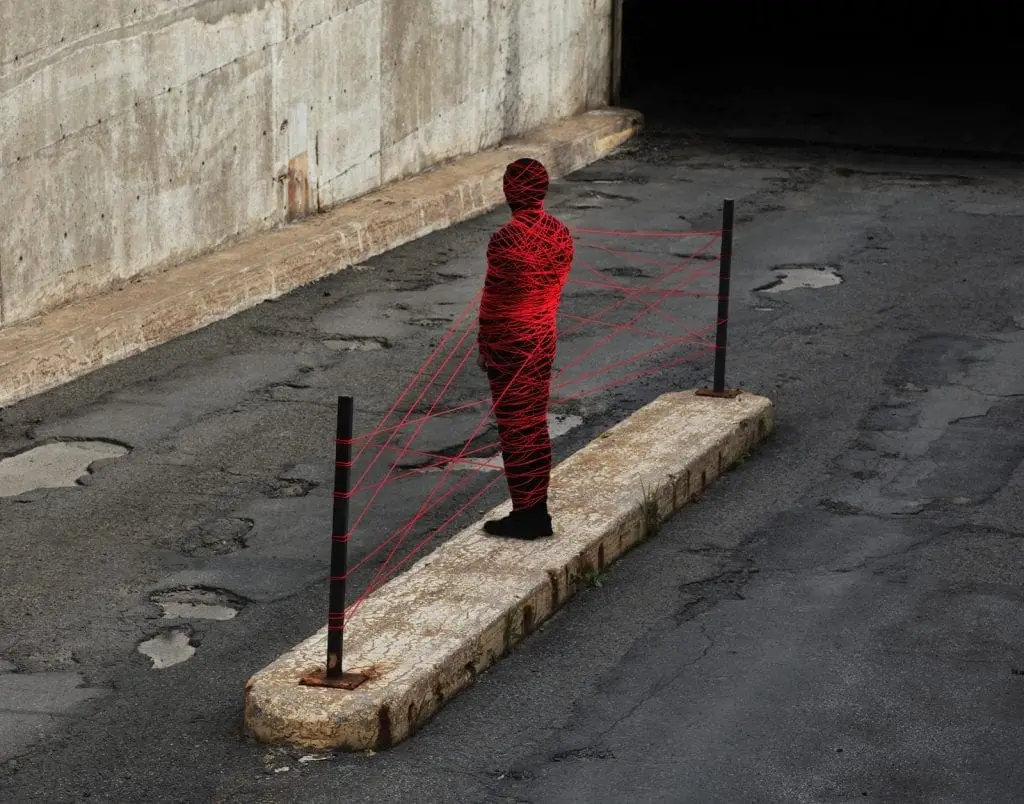
Like many other Sean Mundy’s followers, I bumped into his artwork on social media. Sean’s works have more than once frozen my fingertips when I was insouciantly scrolling down Instagram feeds. His visual art struck people without making them uncomfortable, as it’s bizarre and surreal enough that you know it’s not real-life, yet it is thought-provoking enough to draw you in.
The disruptive power of Sean’s visual art has made its way to semi-viral on the over-saturated social media. And the millennial artist also had his work exhibited in galleries around the world. As an emerging photographer and digital artist, Sean probes at ideas/concepts from isolation, collectivism/individualism to contemporary social/political issues, but he is reluctant to give any of his work a well-defined narrative — he prefer to let the audience to interact with and reflect to his creations however relevant.
I had the fortune to get in touch with Sean in the early October and had him shared some thoughts and opinions on his creation process, the social environment, and how his art will engage with the audience.
Q: To start with, let’s talk about your recent work 『Conduit』, you created the work during the quarantine time in Canada, how did the pandemic impact on you as a visual artist?
I work alone for the majority of my work, using a tripod and a programmable remote, so quarantine/staying alone in my apartment wasn’t too much of an issue or a change of pace for me. Sometimes for larger scale projects I will require a few friends/assistants to help with an image, so those types of images were put off until later, but for “Conduit” other than having my girlfriend help wrap the wires around me for some of the image the rest was done entirely alone. I’ve wanted to create something with a power line for a while and aimed to create something to probe at themes of power, humans’ relationship with power, and to use a bit of religious iconography as well at the same time. I typically like to leave my images open ended to allow viewers to project their own subjective associations on an image as opposed to having 1 set “narrative” for an image.